Beauty
Spa Queue Management: Calm Treatment-Room Walk-Ins Without a Clipboard
How day spas and wellness lounges run fair walk-in Ticket lines—treatment vs retail Services, room Counters, QR join, and an honest split from spa booking OS tools.
· Esperaly Editorial · 10 min read
A busy spa lounge fails in a quieter way than a hair floor. Guests expect calm. Instead they get a soft voice at reception asking “who was next for massage?”, a therapist hovering between rooms, and a clipboard that only one person trusts. Walk-in facials, express add-ons, and retail pickup share one informal line. That is the job spa queue management is supposed to solve—not another booking calendar, membership OS, or fake #1 ranking for spa software.
This guide is for day spas, massage studios, wellness lounges, and hotel spa desks that take a real share of same-day walk-ins alongside booked treatments. You will get a Ticket, Counter, and Service model that matches treatment-room pacing—not a rewrite of salon queue management software for cut-and-colour chairs. For product context aimed at beauty and wellness floors, see Esperaly for beauty & wellness.
Esperaly’s honest boundary stays the same: Ticket / Counter / Service walk-in queues on devices you already own. We do not sell Mindbody-class booking, deposits, or memberships as a core product, and we do not claim EMR/EHR. No inventing awards.
What spa queue management actually does
Strip the category to the loop that matters when the lounge is full and two treatment lengths share one desk:
- A guest joins with a Ticket (phone QR at arrival, or a tablet at reception)
- They choose a Service that matches real need—massage, facial / treatment, express add-on, retail / product pickup—not an internal room code
- Staff call the next Ticket at a Counter (a reception handoff into a treatment room, or a therapist who can take the next walk-in)
- The lounge stays informed—on the phone Ticket and, optionally, a calm waiting-area display
If a product cannot show that loop without a spa-POS sales deck, you are shopping for wellness ops software with a waitlist bolted on—not queue software. The live demo is the fastest way to see join → wait → call on everyday devices.
Why the spa clipboard (and “who’s in room three?”) fails
Paper waitlists work until two walk-ins arrive while a couple’s massage runs long, someone steps out for water, or a membership guest expects to skip because they “always come on Thursdays.” The conflict is not personality—it is an invisible order. Therapists absorb it as doorway interruptions. Reception absorbs it as mediation. Guests absorb it as “this place feels chaotic,” which fights the brand promise of rest.
Digital Tickets make order visible. Guests see place in line. Staff see who is next without whispering across the lounge. When someone challenges fairness, you have a sequence to point at instead of memory. That alone often pays for the tool on a single peak afternoon.
For the broader trade-off between phone-based virtual waits and classic walk-in tickets, read virtual queue vs walk-in ticket queue. Spas usually want both: a soft wait (phone) plus a clear call when a room is free—without turning the lounge into an airport boarding zone.
Map treatment rooms with Services and Counters
Spa queue projects fail when teams copy salon naming (cut / colour / nails) or invent twelve Services nobody will tap. Start with the jobs that actually change wait length or room type.
Services that match how guests actually ask
- Massage / bodywork — longer room occupancy; therapist pacing
- Facial / skin treatment — different room setup and clean-down time
- Express / add-on — short wax, brow, or upgrade that should not sit behind a 90-minute massage if you staff it separately
- Retail / product pickup — when the shop desk shares the lounge and steals therapist attention
- Next available treatment — only if you truly rotate walk-ins across open rooms
Prefer names a first-time guest would tap without asking reception to translate. If two Services always share the same people and the same wait, merge them. Split only when the wait or room path is genuinely different—the same decision pattern as when to split queue Services, applied to treatment rooms instead of civic windows.
Counters as rooms and therapists, not “user seats”
In Esperaly terms, a Counter is capacity that can call the next Ticket—an open treatment room that accepts walk-ins, a therapist ready for the next bodywork Ticket, or a retail desk that can clear pickups. You are buying capacity, not a login. That maps cleanly to spa maths: open two walk-in rooms on Saturday, pay for two Counters; run a quieter Tuesday with one. Details live on pricing.
If you are still guessing how many rooms you need at peak, work the arrival and service-time numbers with how many counters do you need and the wait-time estimator. “We have four therapists on the rota” is not the same as “we have four usable Counters for walk-ins right now”—rooms in turnaround do not count.
Treatment-room vs retail walk-ins (do not mix the waits blindly)
The spa-specific failure mode is mixing a five-minute serum pickup with a sixty-minute massage in one invisible list. Guests with short jobs feel trapped; therapists feel guilty skipping people. Name separate Services when the job lengths diverge, then decide whether Counters are shared or dedicated.
- Shared reception Counter — works when one host routes every Ticket and rooms pull from the matching Service list
- Retail Counter + treatment Counters — better when the shop desk can clear pickups without stealing a massage room
- Express bay — if short add-ons have their own chair or room, give them a Counter so they stop hiding behind long treatments
Hair and nail floors have a related chair problem—see the salon walk-in guide—but spa pacing is room-bound: clean-down, couples suites, and quiet-lounge expectations change how you call Tickets. Do not paste salon Service names onto a treatment map and call the article done.
QR join vs reception tablet (use both)
Most spa lounges should default to QR join and keep a tablet as backup:
- QR on a stand near the door — guests scan, pick a Service, hold a live Ticket. No app store. See QR join.
- Reception tablet — for empty batteries, accessibility needs, or guests who prefer staff to issue the Ticket.
- Phone Ticket as the lounge — guests can wait in the car, café, or changing area without clustering the doorway. Pair with phone tickets.
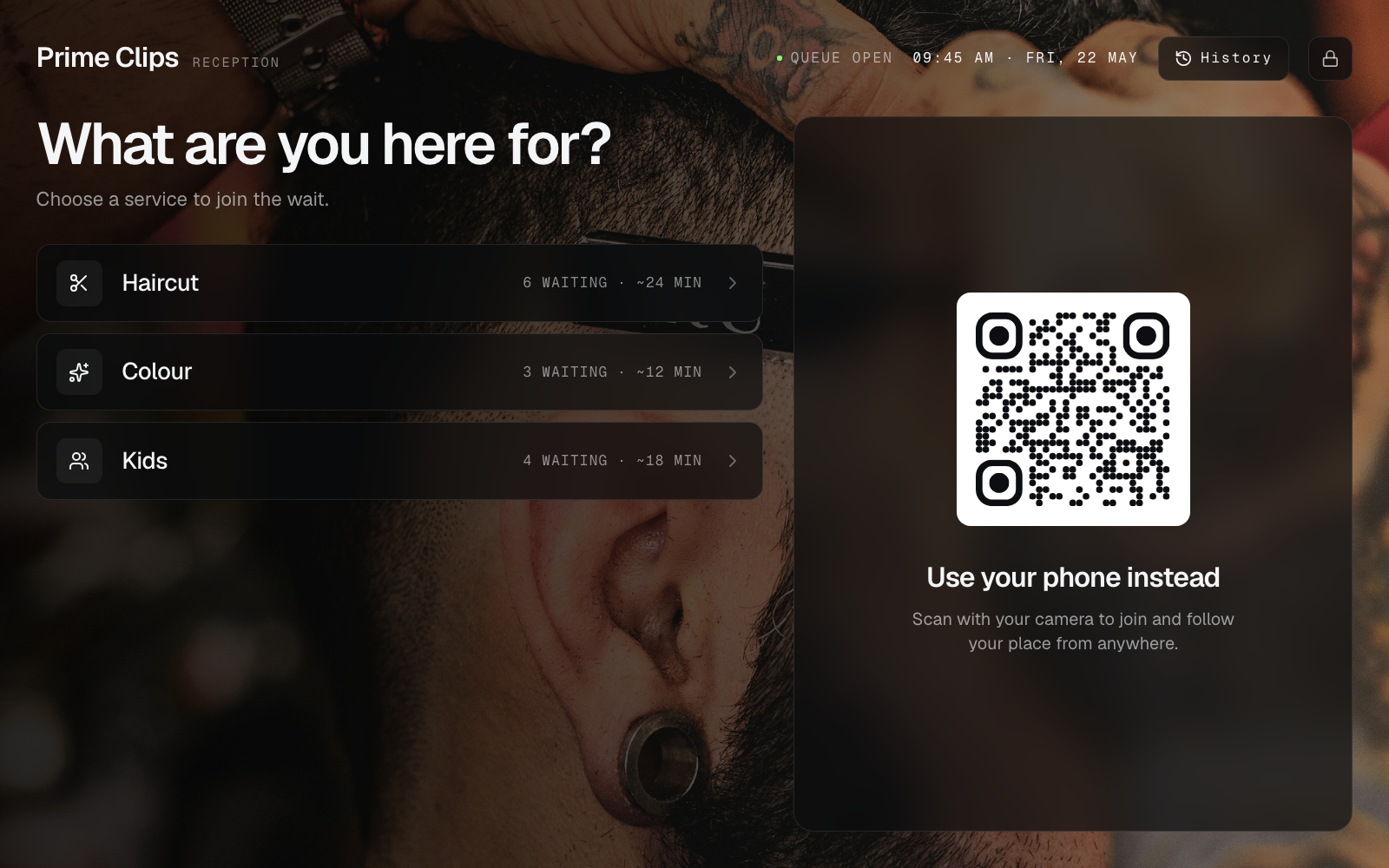
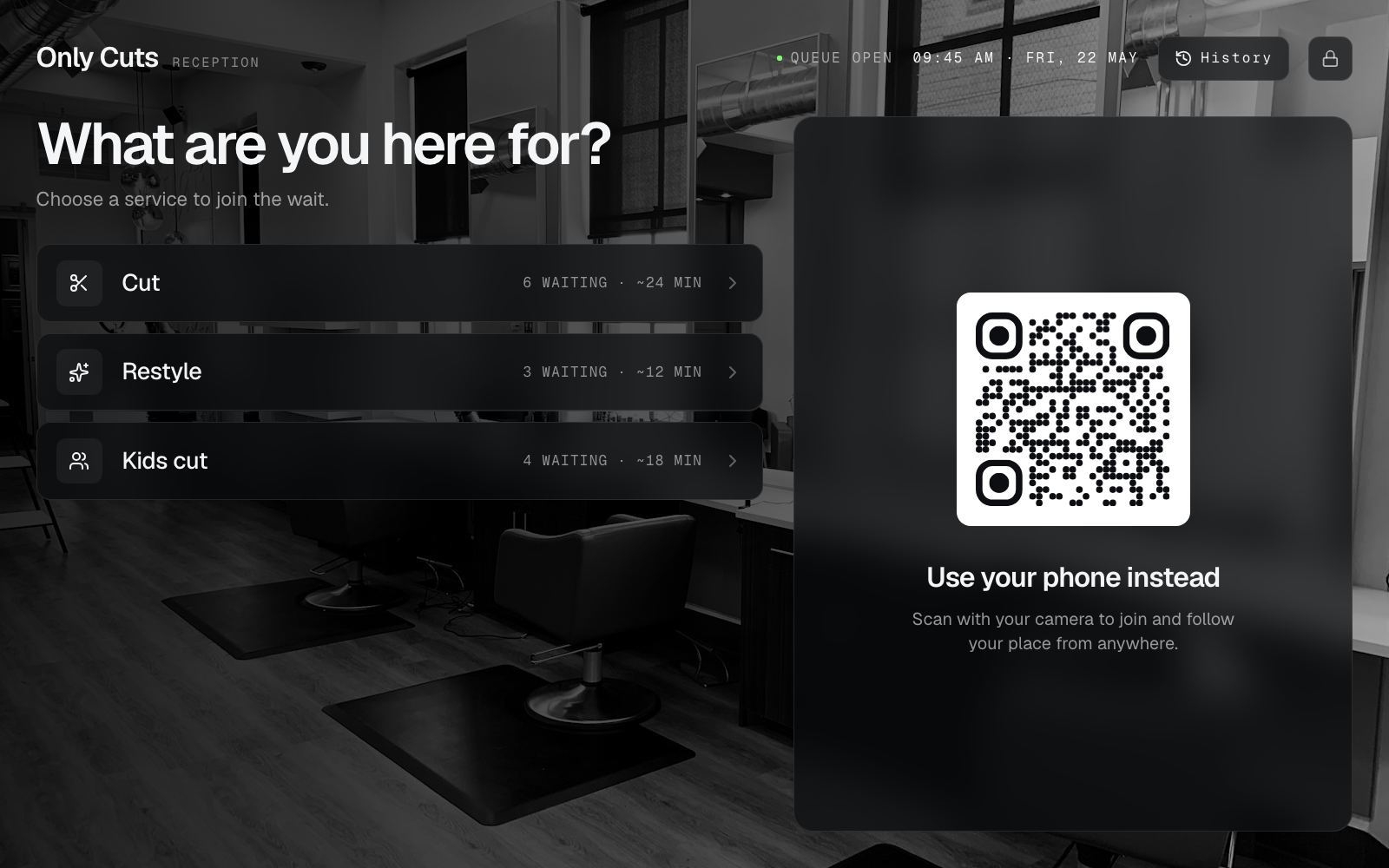
You do not need a pedestal kiosk on day one. A phone stand and a tablet you already own is enough—covered in do you need expensive queue hardware. This is the join screen on that tablet—two example beauty/wellness skins, not real brands:
Waiting-area displays without killing the spa mood
A calm board helps when guests put phones away under soft lighting, or when therapists cannot shout names across treatment halls. Keep it premium:
- Show who was called and who is next—not a wall of spa-day promos
- Use a TV or tablet you already mount for ambient loops
- Avoid flashing “now serving” theatre that fights your lighting and soundscape
- Match the same Ticket numbers staff see on the Counter screen—see waiting-room display and the companion post on queue display board software
The display is a fairness mirror, not a second product. If the Counter call and the board disagree, guests will trust neither—and the lounge feels louder, not calmer.
Walk-in queues vs spa booking software (keep the boundary honest)
Many spas run appointments and walk-ins on the same day. Booking tools excel at calendar holds, deposits, memberships, and reminders. Queue tools excel at fair same-day order when people show up without a perfect slot. You can keep Mindbody, Zenoti, Booker, or a similar spa OS as the spine—and still run walk-in Tickets for overflow, express add-ons, and retail.
Esperaly is Ticket / Counter / Service flow—not a spa booking OS and not an EMR. It will not replace deposits, staff rotas, treatment menus, or a month-grid calendar. Reception’s job is still to interleave: a booked guest at their time; a walk-in holding a Ticket until a Counter is free for that Service. Overflow from a no-show still goes to the next matching Ticket. For no-show habits on walk-in lines, see reducing walk-in queue no-shows.
If you are evaluating Waitwhile-style tools that lean into waitlists plus messaging, compare the fit notes on Esperaly vs Waitwhile. If you want a broader SMB checklist without a fake #1 trophy, use the small-business buyer guide.
Floor rules that keep therapists in the room
Software fails when habits stay sticky-note. Agree on a few rules before go-live:
- One call path — only the Counter screen (or a named host) calls the next Ticket. No competing “I’ll take her from the sofa”
- Transfer on purpose — if a massage consult becomes an express Ticket, transfer Services instead of inventing a side list
- Pause when rooms are blocked — clean-down and couples suite prep are not “available”; do not leave a Counter open if nobody can take a walk-in
- Close the queue when you are full — better than a 90-minute phantom wait that burns the calm brand
- Train the loop, not the feature list — weekend cover should know join → call → serve in five minutes; see staff training for call-next
Reducing walkaways is mostly about clarity, not SMS theatre. Messaging helps when you measure abandonments and budget for it; it is optional until the visible Ticket order works. Do not buy a queue product because it promises to become your entire spa OS.
A same-week setup for a day spa or massage studio
You do not need a four-week implementation. A realistic path:
- Morning 1 — name 2–4 Services; decide which rooms are walk-in Counters today
- Afternoon 1 — print or stand a QR; put the Counter view on a phone or tablet at reception
- Quiet hour — staff join test Tickets, call them, confirm the display (if any) matches
- First peak — run live with one host watching for shadow clipboards; kill the shadow list the same day
- End of week — review wait complaints, abandonments, and whether Service names confused anyone (especially retail vs treatment)
For a generic launch checklist, reuse set up a digital queue in under an hour. Spa-specific work is mostly naming Services and deciding which rooms accept walk-ins versus appointment-only.
What to evaluate before you buy
Score vendors yourself. Useful questions for spa owners:
- Can a guest join in under a minute without installing an app?
- Can staff answer “who’s next?” on one screen?
- Does pricing follow rooms/Counters, or per-user seat taxes you will resent by month two?
- Can you go live this week on devices you already own?
- Does the vendor pressure you into proprietary kiosks or a full spa-POS rewrite before the queue works?
- Are they honest that memberships, deposits, and month-grid booking stay where they already work—and that Esperaly is the walk-in Ticket layer, not that OS?
Run the monthly cost against your desk or room count with the queue cost calculator. Skip vanity feature theatre—the companion post what to ignore when buying queue software still applies on a wellness floor. Collect only what you need on the Ticket—see QR Ticket privacy basics.
When to wait before buying
Queue software is the wrong first project if:
- Wi‑Fi at reception cannot keep a phone online
- Leadership has not decided which rooms accept walk-ins versus appointment-only
- The real pain is membership billing, gift-card POS, or staff commission—not the lounge line
- Nobody will own the host habits for the first peak weekend
Fix those first. A clean Ticket system with no owner becomes optional decoration by Friday.
Get a calmer lounge this week
Spa queue management earns its keep when walk-ins know their place, therapists stay in the room, and reception stops mediating memory. Start with clear Services for treatment vs retail, honest Counter capacity, and a QR guests can scan without a lecture.
When you are ready to test with your real Service names, start a 14-day trial or explore beauty & wellness positioning. Prove join → wait → call on one quiet morning. If that loop feels obvious to your team, you have the right class of tool.