Attractions
Attractions Ticketing Desk Queue Management: Fair Lines Without the Crowd Crush
How museums, scenic railways, and visitor centres run fair walk-in Ticket lines—Services, Counters, QR join, and an honest split from timed-entry and ticketing platforms.
· Esperaly Editorial · 10 min read
Peak Saturday at a visitor centre looks familiar everywhere: a ticket window buried behind a shoulder-to-shoulder crowd, a ferry boarding call that half the lobby cannot hear, and a family asking “are we next?” while three school groups press toward the same gate. Invisible order turns into congestion before the experience even starts. That is the job attractions queue management at the ticketing desk is supposed to solve—not a full theme-park OS rewrite, not a timed-entry CRM with a waitlist bolted on, and not another appointments calendar sold as visitor flow.
This guide is for museums, scenic railways, wildlife reserves, visitor centres, cable cars, ferry terminals, and mid-size attractions that run real same-day walk-up traffic at a ticketing or boarding desk. You will get a clear Ticket, Counter, and Service model, a practical floor setup, and an honest split between queue software and the ticketing or booking tools you already use. For industry context, see Esperaly for attractions.
What attractions ticketing-desk queue management actually does
Strip the category to the loop that matters when the lobby fills and the next departure is twenty minutes out:
- A visitor joins with a Ticket (phone QR at the desk, or a tablet at the entrance)
- They choose a Service that matches real need—entry tickets, guest services, groups, tour check-in—not internal POS SKUs
- Staff call the next Ticket at a Counter (a ticket window, boarding gate, or help desk that can take the next person)
- The room stays informed—on the phone Ticket and, optionally, a lobby or platform board
If a product cannot show that loop without a sales deck about ride-level capacity optimisation, people-counting cameras, or a full park CRM you did not ask for, you are shopping for a different category. The live demo is the fastest way to see join → wait → call on everyday devices.
Why the rope line (and shouted boarding calls) fails at peak
Physical ropes and voice calls work until two coach parties arrive together, a family needs height checks while someone else only wants a map, or a late ferry announcement pulls half the lobby forward at once. The conflict is not personality—it is an invisible order. Desk staff absorb it as constant interruptions. The lobby absorbs it as a crowd that blocks exits and gift-shop doors. Guests absorb it as “this place feels chaotic,” which is a brand problem before they have even boarded.
Digital Tickets make order visible. Visitors see place in line. Staff see who is next for each Service without guessing across windows. When someone challenges fairness, you have a sequence to point at instead of memory. That alone often pays for the tool on a single peak holiday weekend— especially when ticket sales, group desks, and guest services share one lobby.
For the broader trade-off between phone-based virtual waits and classic walk-in tickets, read virtual queue vs walk-in ticket queue. Attractions usually want both: guests wait in the café, outside, or near the shop while holding a Ticket, then return when their Counter is free—or when boarding starts for their group.
Map the desk with Services and Counters
Attraction queue projects fail when teams invent twelve Services nobody will pick, or copy ride-ops jargon onto a simple ticketing desk. Start simple and match how visitors actually answer “what do you need?”
Services that match real visitor jobs
- Tickets / entry — buy or collect general admission; the bulk of many walk-up mornings
- Guest services — maps, memberships, height checks, lost-and-found; wrong to bury inside a generic “help” SKU nobody understands
- Groups / schools — coach parties and school bookings that should not sit behind a never-ending stream of single tickets
- Tours / timed sessions — guided walks or reserved session check-in when that stream is truly different from walk-up entry
- Boarding / departure — only if the desk also calls people to a platform or gate in order; merge with tickets if it is the same window
Prefer names a guest would tap without asking staff to translate. If two Services always share the same wait and the same window, merge them. Split only when the wait or staffing path is genuinely different—similar to how multi-desk teams use multi-counter setups.
Counters as desk or gate capacity, not “user seats”
In Esperaly terms, a Counter is capacity that can call the next Ticket—usually a ticket window, sometimes a second guest-services desk or a boarding gate on a busy platform. You are buying capacity, not a login. That maps cleanly to venue maths: run one Counter on a quiet weekday, open a second on school-holiday Saturdays if two windows serve independently. Details live on pricing.
If you are still guessing how many windows you need at peak, work arrival and service-time numbers with how many counters do you need and the wait-time estimator. “We have four people on the floor” is not the same as “we have a Counter free to call the next walk-up right now”—someone may be handling a group check-in or walking guests to the platform.
QR join vs tablet at the ticketing desk (use both)
Most attractions should default to QR join and keep a tablet as backup:
- QR at the desk and outside the lobby — visitors scan, pick a Service, hold a live Ticket. No app store. See QR join.
- Entrance tablet — for empty batteries, accessibility needs, international guests without data, or visitors who prefer staff to issue the Ticket.
- Phone Ticket as the waiting room — guests can wait in the café, gift shop, or car park. Pair with phone tickets.
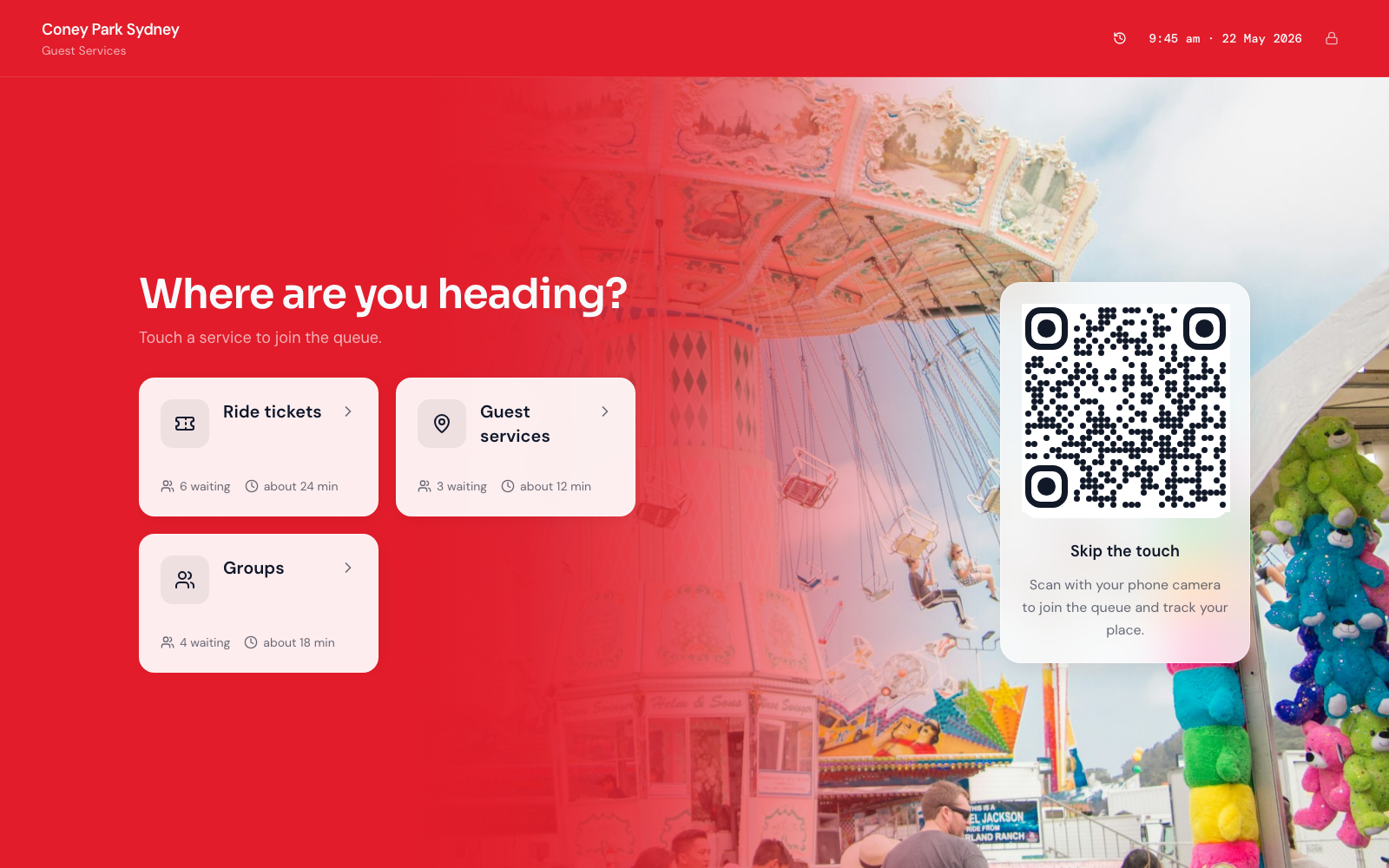
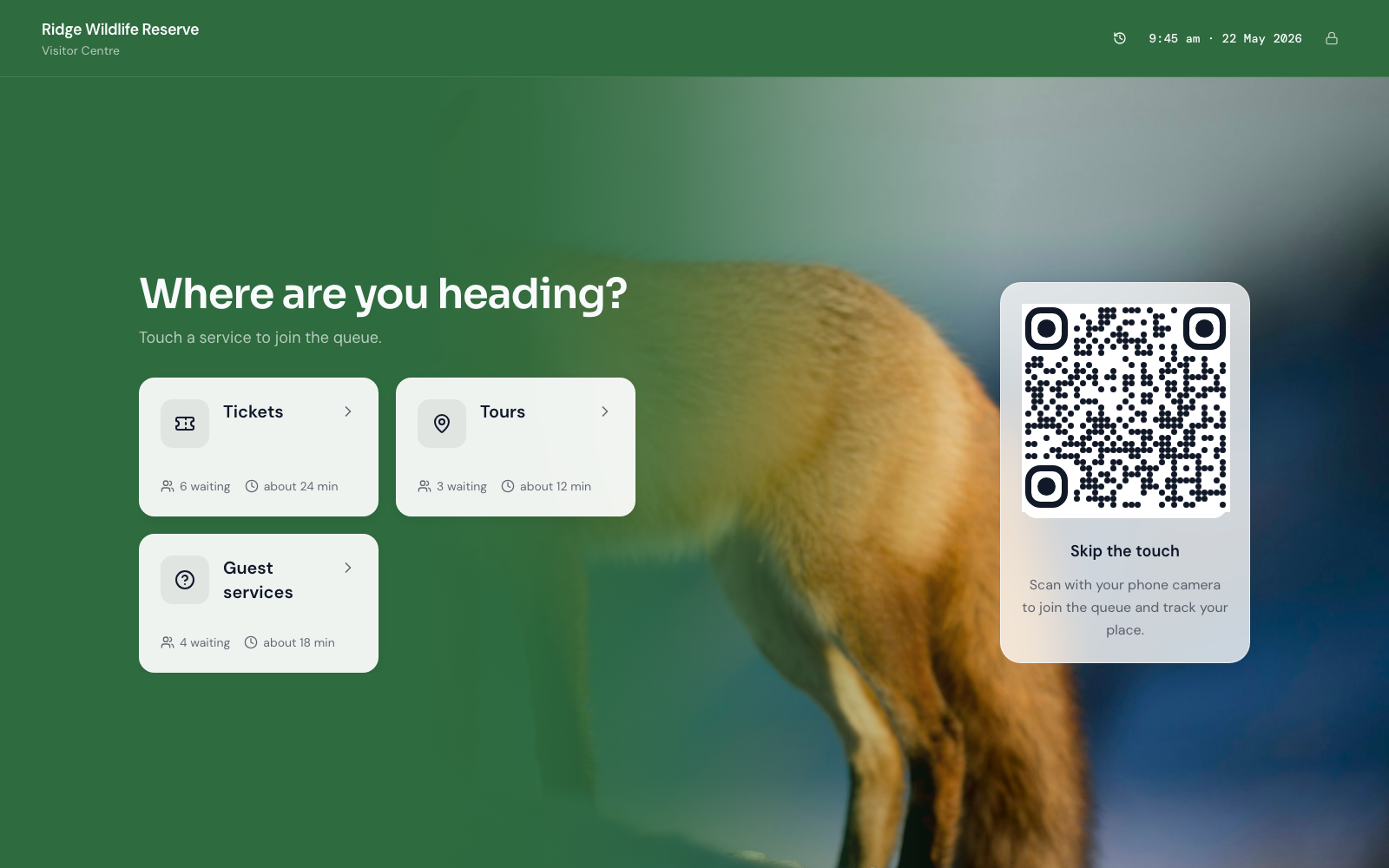
You do not need a pedestal kiosk on day one. A printed QR and a tablet you already own is enough—covered in do you need expensive queue hardware. That is also why attractions queue tools should not force a proprietary dispenser before the join → call loop works. This is the join screen on that tablet—example venues, not real brands:
A lobby or platform board without turning the venue into an airport
A calm board helps when the lobby is noisy, phones stay in pockets, or families share one screen. Keep it visitor-friendly:
- Show who was called and who is next—not a wall of promo carousels
- Use a TV or tablet you already mount near the desk or gate
- Avoid flashing “now serving” theatre that fights a calm museum or wildlife brand
- Match the same Ticket numbers staff see on the Counter screen—see waiting-room display and queue display board software
The display is a fairness mirror, not a second product. If the desk call and the board disagree, guests will trust neither—and you will get a surge toward the rope every time an announcement plays.
Walk-up desks vs timed entry and ticket systems (keep the boundary)
Many attractions run pre-booked timed entry and same-day walk-ups on the same morning. That does not mean one vendor must own every system. Ticketing and booking tools excel at inventory, barcodes, membership pricing, and advance slots. Queue tools excel at fair same-day order when people show up without a perfect slot—or when walk-ups pile up while a booked group finishes check-in.
Esperaly is Ticket / Counter / Service flow—not a timed-entry CRM and not a POS rewrite. It will not sell inventory, memberships, or barcodes. Keep the ticketing platform for sold inventory and named bookings. Use a digital queue for the lobby line (and for overflow when a no-show frees capacity you can offer to the next matching Service). Staff’s job is to interleave: a booked tour at their time; a walk-up holding a Ticket until a Counter that fits their Service is free.
If you are evaluating Waitwhile-style tools that lean into waitlists plus messaging, compare the fit notes on Esperaly vs Waitwhile. For a broader SMB checklist without a fake #1 trophy, use the small-business buyer guide—the same honesty applies to a single visitor centre shopping for software. Food halls and host stands are related but different patterns—see hospitality and restaurant waitlist queue management.
Desk rules that keep boarding and ticketing calm
Software fails when habits stay sticky-note. Agree on a few rules before go-live:
- One call path — only the Counter screen (or a named desk lead) calls the next Ticket. No competing “I’ll take them”
- Match Service on purpose — call the next Ticket that fits the free window; do not invent a side list for VIPs or coach drivers unless it is a published Service
- Pause when the gate cannot board — a delayed departure or capacity hold is not “available”; do not leave a Counter open if nobody can serve
- Close the walk-up line when you are full — better than a 90-minute phantom wait that burns trust on a holiday weekend
- Train the loop, not the feature list — seasonal staff should know join → call → serve in five minutes
Reducing lobby hovering is mostly about clarity, not SMS theatre. Messaging helps when you measure abandonments and budget for it; it is optional until the visible Ticket order works. Do not buy a queue product because it promises to become your entire attractions OS.
A same-week setup for a busy ticketing desk
You do not need a four-week implementation. A realistic path:
- Morning 1 — name 2–5 visitor Services; decide which windows or gates are walk-up Counters today
- Afternoon 1 — print or stand a QR; put the Counter view on a phone or tablet at the desk
- Quiet hour — staff join test Tickets, call them, confirm any board matches
- First peak — run live with one lead watching for shadow clipboards or “just this once” side lines; kill the shadow list the same day
- End of week — review walkaways, abandonments, and whether Service names confused tourists
For a generic launch checklist, reuse set up a digital queue in under an hour. Attraction-specific work is mostly naming visitor Services and deciding how desks interleave booked entry with walk-ups.
What to evaluate before you buy
Score vendors yourself. Useful questions for venue managers and guest- services leads:
- Can a visitor join in under a minute without installing an app?
- Can staff answer “who’s next for groups?” on one screen?
- Does pricing follow desks/Counters, or per-user seat taxes you will resent by month two?
- Can you go live this week on devices you already own?
- Does the vendor pressure you into proprietary kiosks or a ticketing rewrite before the queue works?
- Are they honest that bookings and POS stay in your existing tools if those already work?
Run the monthly cost against your desk count with the queue cost calculator. Skip vanity feature theatre—the companion post what to ignore when buying queue software still applies on a visitor floor. If you are comparing Qminder-style multi-location desks, see Esperaly vs Qminder. For Qwaiting-style alternatives, see Esperaly vs Qwaiting.
When to wait before buying
Queue software is the wrong first project if:
- Wi‑Fi at the desk or platform cannot keep a phone online
- Leadership has not decided how walk-ups interleave with timed-entry or pre-booked tours
- The real pain is ride capacity, ferry schedule reliability, or a broken ticketing inventory policy—not the lobby line at the desk
- Nobody will own the host habits for the first peak weekend
Fix those first. A clean Ticket system with no owner becomes optional decoration by Friday of week one.
Get a calmer ticketing desk this week
Attractions queue management earns its keep when walk-ups know their place, desk staff stay in the greeting, and the lobby stops mediating memory. Start with clear visitor Services, honest Counter capacity, and a QR guests can scan without a lecture.
When you are ready to test with your real Service names, start a 14-day trial or explore attractions positioning. Prove join → wait → call on one quiet weekday. If that loop feels obvious to your team, you have the right class of tool.